

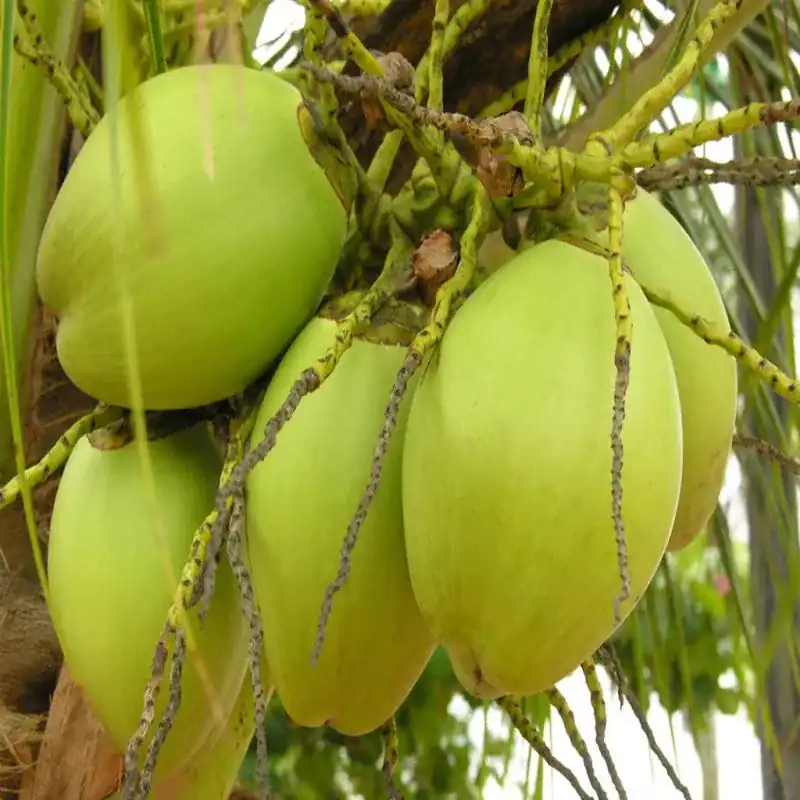
Coconut Desi Plant
Fruit
View & Listen Plant Education

Coconut Desi Plant - Video Guide
Watch Video
All Details
I am the Desi Coconut, the timeless sovereign of the tropical coastline. My tall, slender, gracefully curving trunk is crowned with a majestic fountain of giant, feather-like fronds. I bear the iconic clusters of large, fibrous-husked nuts—a symbol of life, sustenance, and resilience, offering shade, food, drink, and materials from root to tip.
I am the classic, tall-growing variety of coconut palm (Cocos nucifera), a true tropical icon. I am a "life-giving tree" in coastal communities, valued not for compact size but for maximum yield, height, and traditional utility in all my parts.
Native to the coastal tropics of the Indo-Pacific region (likely Melanesia). Has been spread by humans and ocean currents for millennia and is now ubiquitous across the world's tropical coastlines.
Requires regular, deep watering when young to establish. Mature trees are highly drought-tolerant due to deep roots but thrive and produce best with consistent soil moisture, high humidity, and access to groundwater.
Demands full sun from seedling stage onwards. Cannot tolerate shade and will grow weakly or die without intense, direct sunlight all day.
A strict tropical tree. Thrives in consistently warm, humid climates (25-32°C). Growth stops below 15°C, and frost or prolonged cold is fatal.
Plant in very deep, sandy, well-drained soil in an open, sunny location. Requires massive space for its full height and root spread. Never suitable for small gardens. Planting near structures is hazardous due to falling fronds and nuts.
Benefits from regular applications of palm-specific fertilizer high in potassium (K) and magnesium, with micronutrients like boron. Apply during the rainy/growing season. Salt tolerance allows for some seaside fertilization.
Botanical name: Cocos nucifera (Tall Variety); Common names: Tall Coconut, Traditional Coconut, Nariyal, Thengu, Tenga; Family: Arecaceae.
The raw nut and husk can pose a choking hazard. The shell can cause intestinal blockage if ingested. Falling nuts and fronds are a severe physical safety hazard to all animals and people.
Very High. As a massive, perennial evergreen, it is a powerhouse for oxygen production and carbon sequestration. Its large canopy provides significant cooling and humidification of the local microclimate.
The ultimate multi-purpose tree: provides coconut water, oil, milk, and flesh; coir from husk; timber and thatch from trunk and fronds; symbol of tropical life and hospitality; critical for coastal soil stabilization and ecology.
Vulnerable to lethal yellowing disease, rhinoceros beetle, and red palm weevil. Falling fronds and coconuts are a major liability. Requires a vast amount of space and specific climate. Slow to mature and begin fruiting (5-10 years).
Extremely long-lived. Productive for 60-80 years after maturity, and can live over 100 years. Grows 20-30 meters tall or more.
Everyday 8:30AM to 6:30PM

Akola, Road, Badnera, Amravati, Maharashtra 444701