

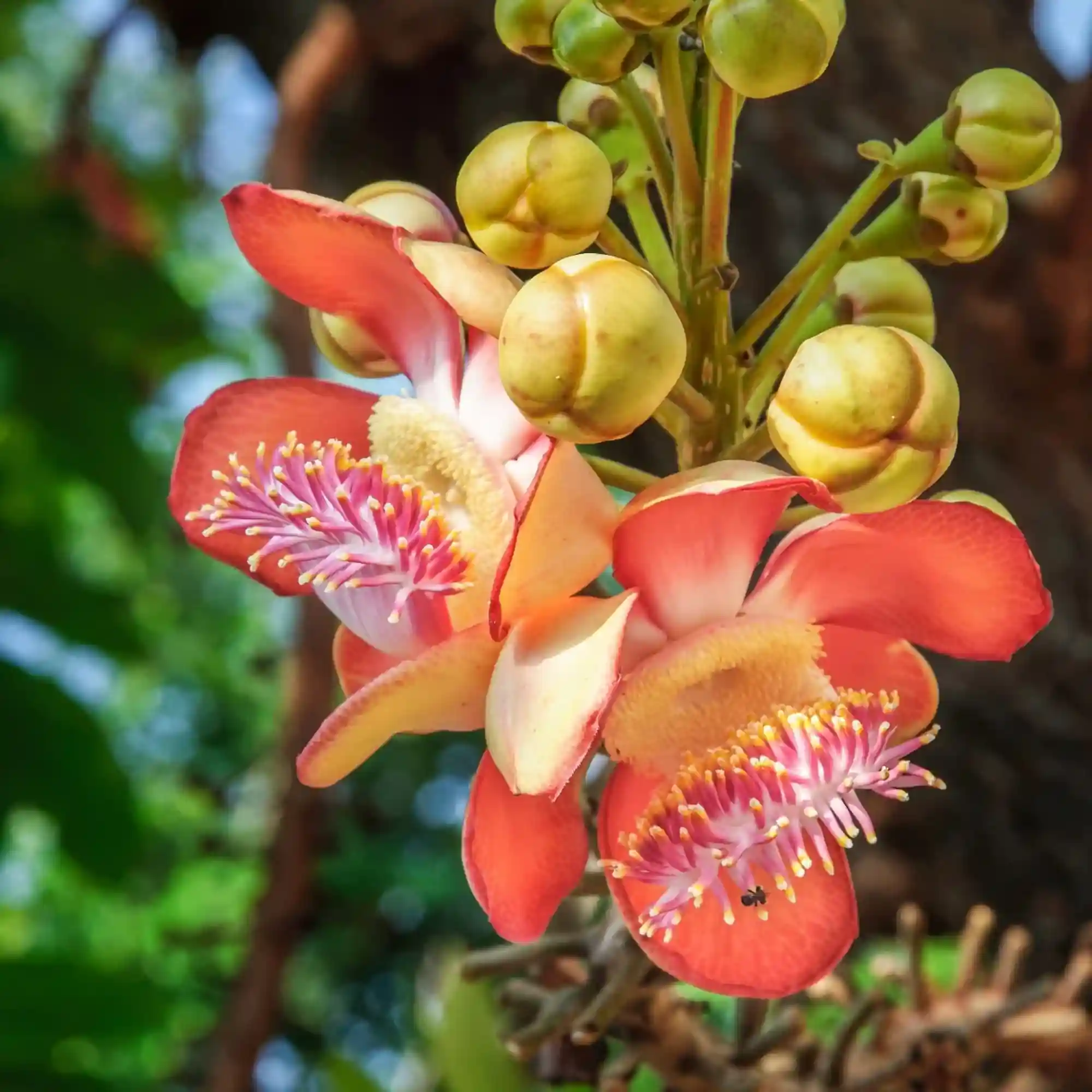
Cannonball Tree Plant
Flowering
View & Listen Plant Education

Cannonball Tree Plant - Video Guide
Watch Video
All Details
I am the Cannonball Tree, the dramatic sculptor of the rainforest. My gnarled, buttressed trunk is adorned directly with stunning, waxy, pink-and-scarlet fragrant flowers that give way to massive, spherical, woody fruits—resembling cannonballs—that hang ominously and audibly from my branches, creating a scene of breathtaking, primal wonder.
I am a large, tropical, deciduous tree famous for my extreme cauliflory (flowers and fruits growing directly on the trunk and main branches) and my enormous, heavy fruits. I am a botanical curiosity and a sacred tree in Hinduism.
Native to the tropical rainforests of Central and South America, but has been introduced and is now revered and widely cultivated in tropical botanical gardens and temple grounds across South and Southeast Asia.
Requires regular, deep watering when young. Mature trees have high water needs, especially during the flowering and fruiting season, and thrive in areas with high rainfall or consistent irrigation.
Demands full sun for many hours a day to grow strongly and produce its spectacular floral and fruit display.
A strictly tropical tree, thriving in consistently warm and humid climates (22-35°C). It is extremely sensitive to cold and any frost will kill it.
Plant in deep, rich, moisture-retentive but well-drained soil. Requires an enormous amount of space due to its wide-spreading canopy, buttressed roots, and the hazardous falling fruits. Must be planted far from paths, buildings, and parking areas.
Benefits from regular feeding with a balanced, slow-release fertilizer during the growing season to support the immense energy required for flowering and fruiting.
Botanical name: Couroupita guianensis; Common names: Cannonball Tree, Nagalingam, Sala, Kailaspati, Ayahuma; Family: Lecythidaceae.
The fruit pulp has a strong, often unpleasant odor and is not considered edible. While not prominently listed as highly toxic, it is certainly not for consumption, and the falling fruits pose a severe physical hazard.
High. As a massive tropical tree with large leaves, it contributes significantly to oxygen production, carbon sequestration, and creating a cooler microclimate.
The extraordinary flowers are sacred to Hindus, offered to Lord Shiva, and the tree is commonly planted in temple precincts (especially Shiva temples, where it is called Nagalingam). It is a major tourist and educational attraction in botanical gardens due to its unique appearance.
The heavy, falling fruits are a major safety hazard and can cause significant damage. The fragrant flowers attract bees and insects in large numbers. Requires a very large, specific tropical habitat to thrive.
Long-lived perennial tree. Can live for several decades, growing 25-35 meters tall. The trunk can become massive with prominent buttresses.
Everyday 8:30AM to 6:30PM

Akola, Road, Badnera, Amravati, Maharashtra 444701