

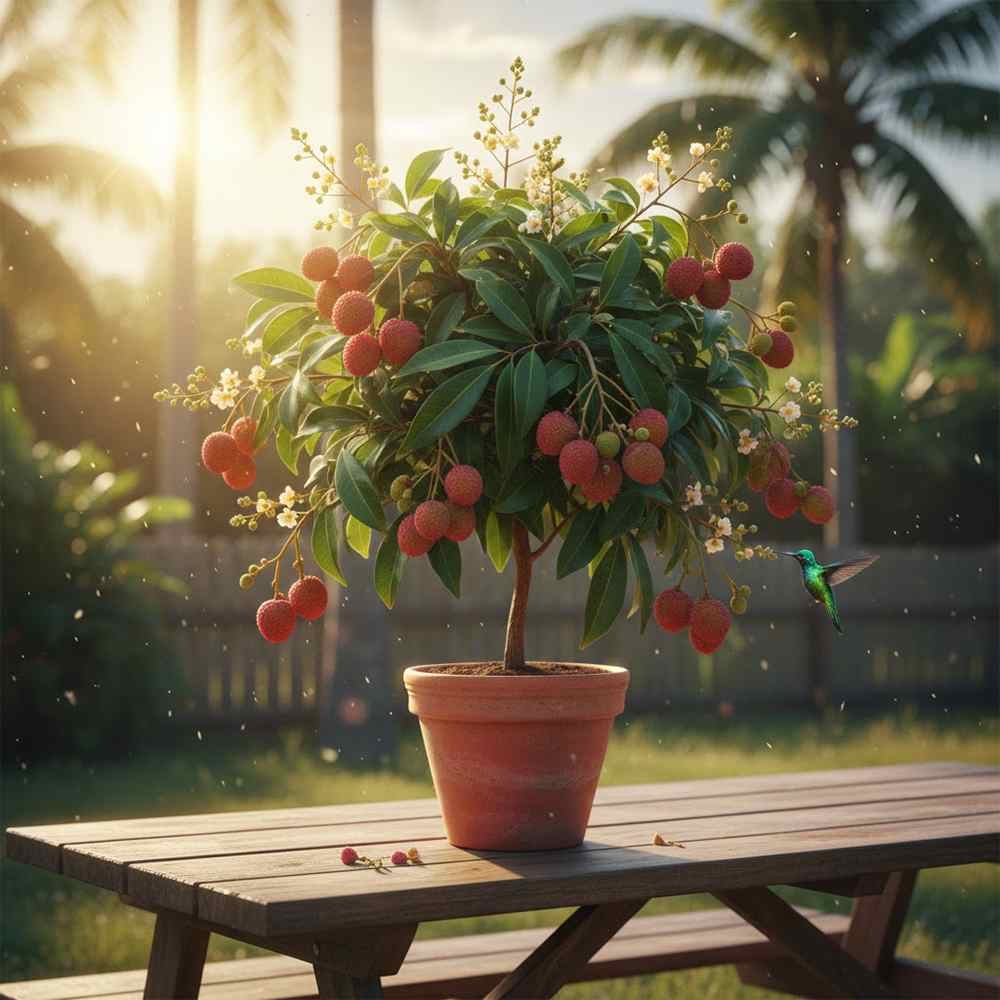
Litchi Plant
Fruit
View & Listen Plant Education

Litchi Plant - Video Guide
Watch Video
All Details
I’m a tropical evergreen tree that produces sweet, juicy, rose-scented litchi fruits covered in a red bumpy shell.
I am a medium to large evergreen tree with a dense, spreading canopy and dark, shining foliage, often reaching heights of 10-12 meters when mature.My most precious feature is my fruit: a round to heart-shaped drupe covered in a thin, rough, bumpy skin (rind) that turns bright red or pink upon ripening. The edible portion is the sweet, juicy aril (flesh) surrounding the seed.My leaves are pinnate, having 4 to 8 alternating, elliptic leaflets.My cultivation demands specific climatic conditions but I reward patience with abundant, highly sought-after fruit.
I am native to Southern China, and I am one of the most commercially important subtropical fruits cultivated across India (especially Bihar, UP, and West Bengal).
I require deep, regular watering and prefer consistently moist (but not soggy) soil, especially during the hot growing season.Young trees (0-3 years) require frequent, shallow watering to establish, often every 2-3 દિવસમાં એક વખત in dry weather.Mature trees need consistent irrigation, particularly during fruit development (January to June) to prevent fruit cracking and severe drop. Water deeply, approximately once a week during this period if rainfall is low.Crucial Period: Water is often withheld 4 months prior to flowering (late autumn/early winter) to induce a rest period, which encourages flower bud formation.
I am a sun-loving fruit tree but prefer subtropical conditions rather than harsh, dry heat.I require 6 to 8 hours of full sun daily for optimal growth and flowering.Young trees (under 3 years) benefit greatly from protection from strong, hot, desiccating summer winds and afternoon sun.
I am a subtropical crop, requiring specific temperature variations for success.Flowering/Fruiting: Requires cool, dry winter temperatures (below 20°C) for flower bud formation, transitioning to warm temperatures (25°C to 35°C) for fruit set.Extreme Limits: I cannot tolerate temperatures above 40.5°C (which causes sunburn and fruit cracking) or freezing temperatures in winter, which can severely injure young trees.
Choose a location with deep, fertile, well-drained loamy soil rich in organic matter. I prefer slightly acidic soil (pH 5.5 to 7.0).Propagation: I am commercially propagated via Air Layering (Gootee), as seed-grown trees take too long to bear fruit.Pits: Dig large pits (1m x 1m x 1m) and fill them with topsoil mixed with farmyard manure (FYM) and other fertilizers/micronutrients before planting.Protection: Plant windbreaks (like Mango or Jamun trees) on the orchard boundary to shield young plants from hot and cold winds.
My nutrient requirements are high for profuse growth and heavy fruiting.Young Trees: Apply increasing doses of Farmyard Manure (FYM), Nitrogen (N), Phosphorus (P), and Potassium (K) annually.Mature Trees: Fertilize with high doses of FYM (up to 60 kg per tree) in September. Nitrogen should be given in split doses (mid-February and after harvest).Fruiting: I especially benefit from Phosphorus and Potassium to encourage flower initiation and fruit development.
Scientific Name: Litchi chinensis Sonn.Common Names: Lychee, Lichi, Lichu, Chinese CherryPlant Family: Sapindaceae (Soapberry Family)Plant Type: Subtropical Evergreen Fruit Tree
The pulp (aril) is edible and safe.CAUTION: The seed, skin (rind), and leaves of the Litchi fruit and tree are reported to contain toxins (like hypoglycin A) and are not safe for consumption by pets or humans, especially children, and should be discarded carefully.
As a dense, evergreen canopy tree, I am highly efficient at absorbing carbon dioxide and releasing oxygen year-round, significantly improving the local air quality and microclimate.
Nutritional Powerhouse: I am a rich source of Vitamin C and B-complex vitamins.Culinary Delight: I am prized globally as an excellent table fruit, often consumed fresh.Economic Value: I am a high-value cash crop in India and support a significant fruit industry.
Fruit Cracking: The skin splits, often due to sudden changes in soil moisture (heavy rain after a dry spell).Fruit Drop: Caused by poor pollination, nutrient imbalance, or inconsistent watering.Pests: Vulnerable to Fruit Fly and Litchi Mite.Irregular Bearing: Requires specific cool/dry winter conditions to induce proper flowering.
I am a legacy tree, growing slowly bu
Everyday 8:30AM to 6:30PM

Akola, Road, Badnera, Amravati, Maharashtra 444701